Half Time Full Time Football Betting from Break to Final Whistle
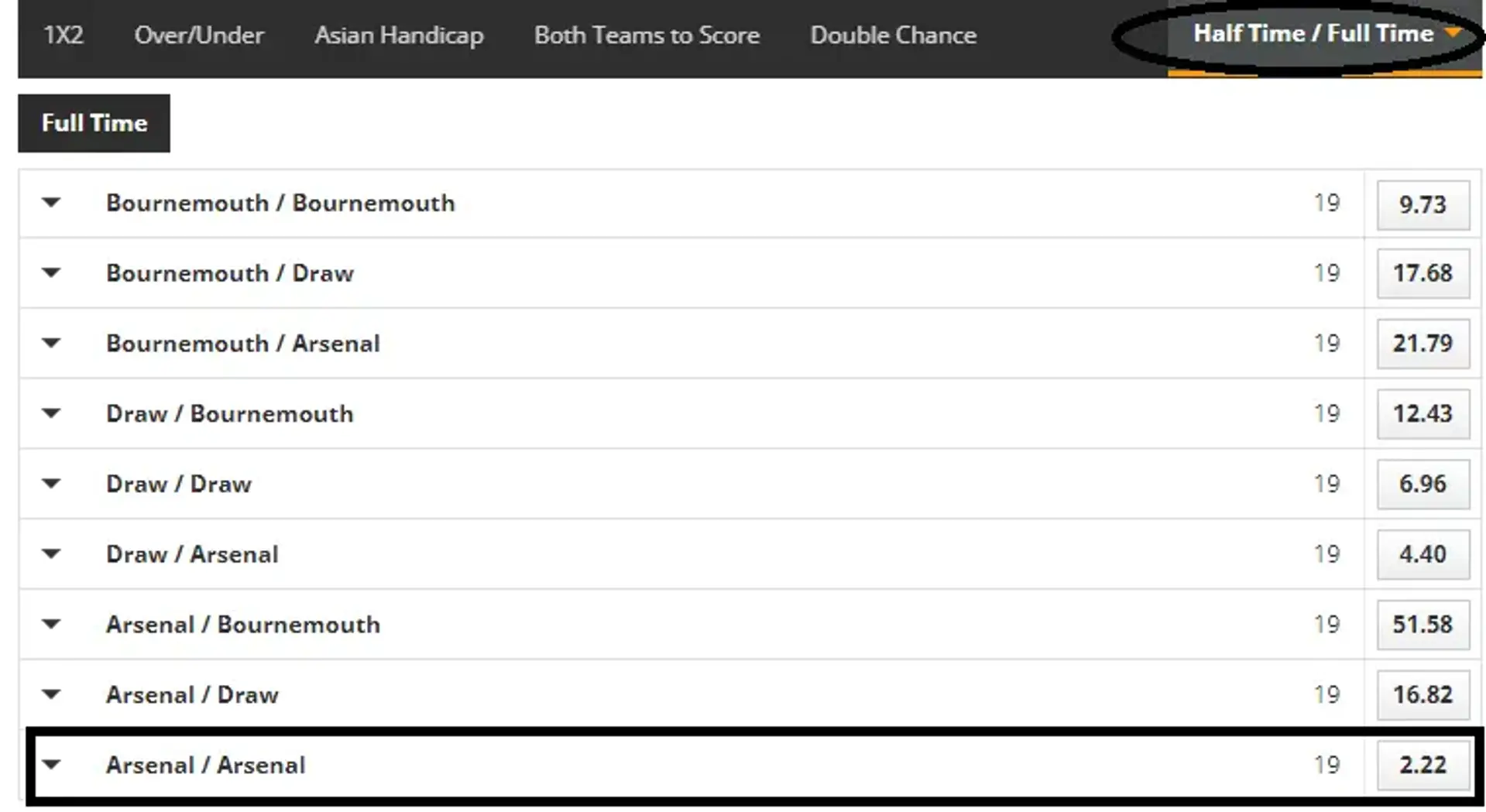
Half time full time football betting combines two result checkpoints in one selection. The first part is settled from the opening half, while the second uses the normal-time result. Both conditions must match the selected pair, which creates nine standard result combinations in a three-way football market.
The first half has its own result
William Hill’s half betting rules settle a specified half only on events that occur during that half, including stoppage time added at its end. Events from the other half do not change that half result.
A team can lead 2-0 at half time and lose 2-3 after the break. The first-half component still remains a home win even though the full-time result has reversed.
Full time means normal time
William Hill defines full time and ninety minutes as normal time, including stoppage time. Extra time and penalty shoot-outs do not count unless the market says otherwise.
That means a knockout match drawn after ninety minutes remains a draw for the full-time part of a standard half-time full-time selection, even if one team later advances.
Both parts of the selection must land
A Home/Home selection requires the home team to lead at half time and win after normal time. Draw/Home requires the first half to finish level before the home side wins the match.
One correct checkpoint is not enough. If the home team leads at half time but the match finishes drawn, Home/Home loses and Home/Draw is the matching result.
Second-half scoring can reverse the full result
The market is especially sensitive to what happens after the interval. A team can trail at half time and still produce a full reversal, depending on venue order and the final score.
This creates longer prices for some combinations because the selection needs a specific sequence of match states rather than one final outcome.
Abandonment depends on which period completed
William Hill states that half markets can stand if the specified half has already been completed before a later abandonment. A first-half result can therefore remain settled even when a second-half event does not finish.
A combined half-time full-time market still needs the full normal-time result. If the match is abandoned before that second checkpoint is completed, the combined selection can remain unresolved under the operator’s abandonment rules.
The same fixture can support several related markets
Half-time result, second-half result and half-time full-time all use different jobs. One measures a single half, another measures the other half, and the combined market requires a sequence across two checkpoints.
The price comparison should therefore stay within the same product. A shorter half-time price should not be treated as an alternative quote for the combined selection.
Sequence-based markets need precise boundaries
The most useful reading starts with the settlement points, then checks the chosen combination. That prevents a final score from hiding the first-half condition that also had to be correct.
The same boundary-first approach is useful in our football booking points article and basketball winning margin guide.